

Developing Reading
"Read as much as you can. Nothing will help you as much as reading" - JK Rowling
Building on the Sounds-Write programme and Talk Through Stories we have developed a rigorous and sequential reading curriculum which fosters our children’s confidence, motivation and sense of being a reader. Emphasis is placed on building fluency at each stage of their reading journey, so children are able to access and understand challenging but age-appropriate texts.
Developing Fluent Readers
At Acklam Whin we understand the ability to decode fluently allows children to comprehend and make sense of what they have read. Our reading curriculum is designed to develop accurate and automatic readers, who can decode easily and therefore have more attention available for the work of comprehension and to read with expression and phrasing.
In Year Two to Year Six, fluency is taught daily at the beginning of each reading session using extracts from a range of texts. We base our fluency approach on The Townsend Research School ‘Phonics to Fluency’. These sessions incorporate quality teacher modelling, repeated reads, choral and echo reading, all of which support the development of children’s expression, automatic word recognition, rhythm, phrasing and smoothness.
Comprehension
Over the course of Year Two and into Key Stage 2, our teaching focus shifts from decoding words, to ensuring our children gain experience and support with listening to, thinking deeply about and discussing a range of rich and challenging texts. Children take part in thirty-minute daily reading lessons, using a variety of genres including non-fiction, fiction and poetry.
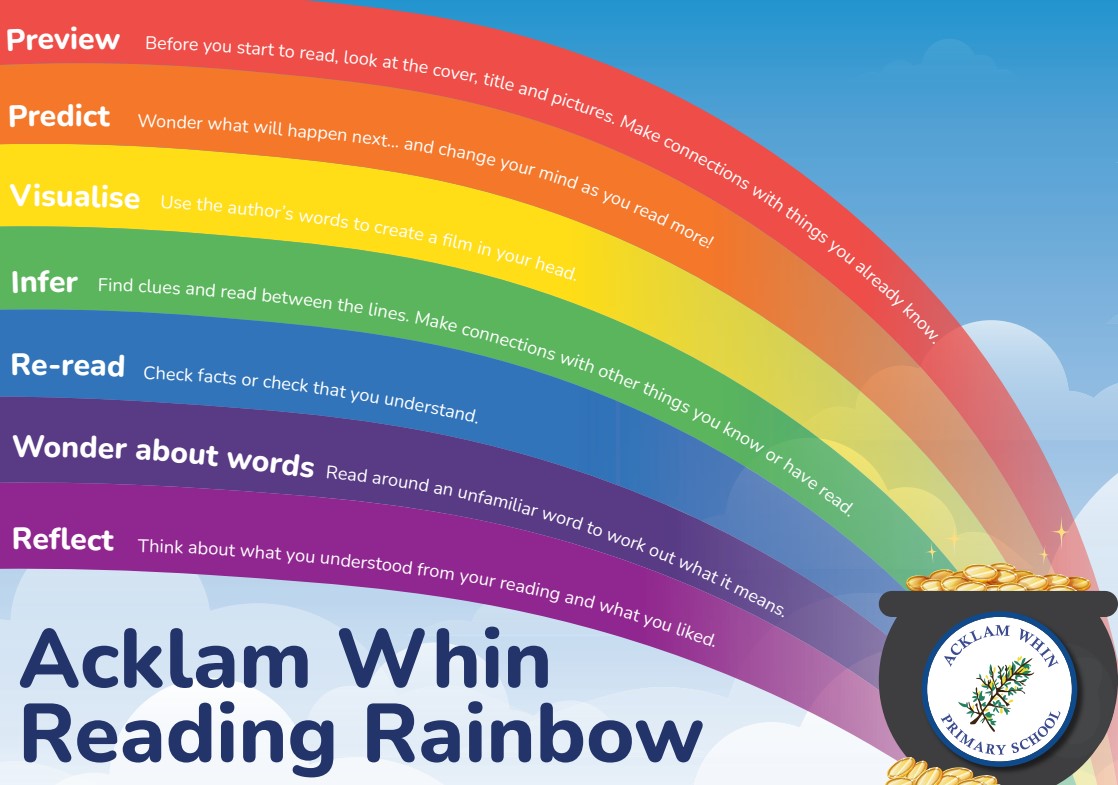
As a skilled reader draws on a variety of strategies at the same time, our weekly reading lessons teach children to use a range of reading strategies simultaneously to gain meaning from what they read. These are displayed on our Reading Rainbow and are referred to throughout our daily reading lessons.
Background Builders
Before exposing children to a text as part of the reading lesson, we develop their background knowledge. Building our children’s background knowledge is essential for reading comprehension as the more they know about a topic, the easier it is to read a text, understand it and retain the information.
Our reading lessons help children to explore new vocabulary, explain the meanings of words in context, retrieve information from the text, interpret the meaning of the text and consider authorial choice.
Book Club
A real highlight of the week for both staff and children are our book club sessions which offer a wonderful opportunity for children to use their oracy skills in a meaningful way.
Dedicated sessions provide high quality classroom talk about books, develop children’s breadth of vocabulary, support our children to evaluate books, make brave and bold reading choices and find their reader identity.
Teachers and children’s recommendations are shared; children discuss favourite books and authors; mystery books and short extracts are read aloud to create interest, intrigue and a real buzz for reading.
Reading Books and Home Reading
Our libraries are stocked with vast range of diverse and high-quality books to support reading practice and develop a love of reading. Adults carefully monitor children’s book choices to encourage engagement, promote different genre choices and to ensure they are age appropriate. Children developing their phonic knowledge and skills will continue to read decodable books.
Children identified as reading below their age-related expectation are directed to our Mystery Read Baskets. These baskets contain carefully selected books in banded levels that ensure children can choose from a range of genres that they are able to read independently whilst still having the excitement of choosing a book they are motivated to read.
Class Novels
Following on from Early Years and Year One, children in Year Two and Key Stage Two are read to every day by their class teacher. These class novels are chosen to promote a love of reading, develop vocabulary, and inspire children to read a greater variety of genres, themes and authors. These stories can be loaned from their classroom libraries to take home and enjoy re-reading.
Additional Help
As reading is the key to accessing the curriculum we ensure children at risk of falling behind receive timely and appropriate support. Progress is closely monitored, and accurate assessment ensures next steps are identified.
Children working below age related expectations are assessed to identify their reading barrier. Those who have gaps in phonic knowledge and skills are placed in Sounds-Write ‘Keep-Up’ or ‘Catch-Up’ interventions. Children needing support with specific reading strategies are targeted in class or given additional tuition in small groups.
Our aim is for children to leave Acklam Whin being able to read text fluently and effortlessly with the skills to read for meaning and with good understanding in preparation for the challenges of the Key Stage Three curriculum.