Maths
"Mathematics is not about number, equations, computations or algorithms: it is about understanding" - William Paul Thurston
Welcome to Maths at Acklam Whin
Maths at Acklam Whin is about developing a secure and deep understanding of fundamental mathematical concepts and procedures that can be applied confidently across a range of contexts both in school and in their own lives. Our Maths curriculum is based upon the Teaching for Mastery approach and is ambitious and achievable for all our children.
Maths is an essential tool for everyday life and our curriculum is designed to build on our children’s prior learning and taught through carefully planned sequence of units in small steps to ensure a deep conceptual understanding of mathematical learning and prepares our children with knowledge and skills to succeed in the future. Challenge for all and making connections is provided through deeper thinking opportunities, practical tasks and real-life problems which ensures all our children are able to recognise the importance of maths in the wider world.
Maths Mastery Curriculum
We believe that a focused and balanced mathematical education is the entitlement of all children, regardless of ethnic origin, gender, ability or special educational need. We are committed to developing children’s curiosity about the subject, as well as an appreciation of the beauty and power of Mathematics.
Our curriculum aims to ensure all our children can:
- Become fluent in the fundamentals of mathematics, so that children have conceptual understanding and can recall and apply their knowledge rapidly and accurately
- Reason mathematically by following a line of enquiry, conjecturing relationships and generalisations, and use mathematical language
- Can solve problemsby applying their mathematics to a variety of routine and non-routine problems
Mrs Prince is a Local Leader of Maths Education (LLME) for Archimedes NE Maths Hub, and the Five Big Ideas of the National Centre for Excellence in the Teaching of Mathematics (NCETM) underpin our teaching approach. These are: coherence, representation and structure, mathematical thinking, fluency and variation. Staff use the Power Maths/White Rose Maths resources to plan units and lesson sequences.
Our Concrete, Pictorial, Abstract Approach
At Acklam Whin, we use the maths mastery Concrete, Pictorial, Abstract approach (CPA). This approach builds on children’s existing knowledge by introducing abstract concepts in a concrete way and develops a deep and sustainable understanding of maths for our children. It involves moving from concrete materials to pictorial representations, to abstract symbols and problems.
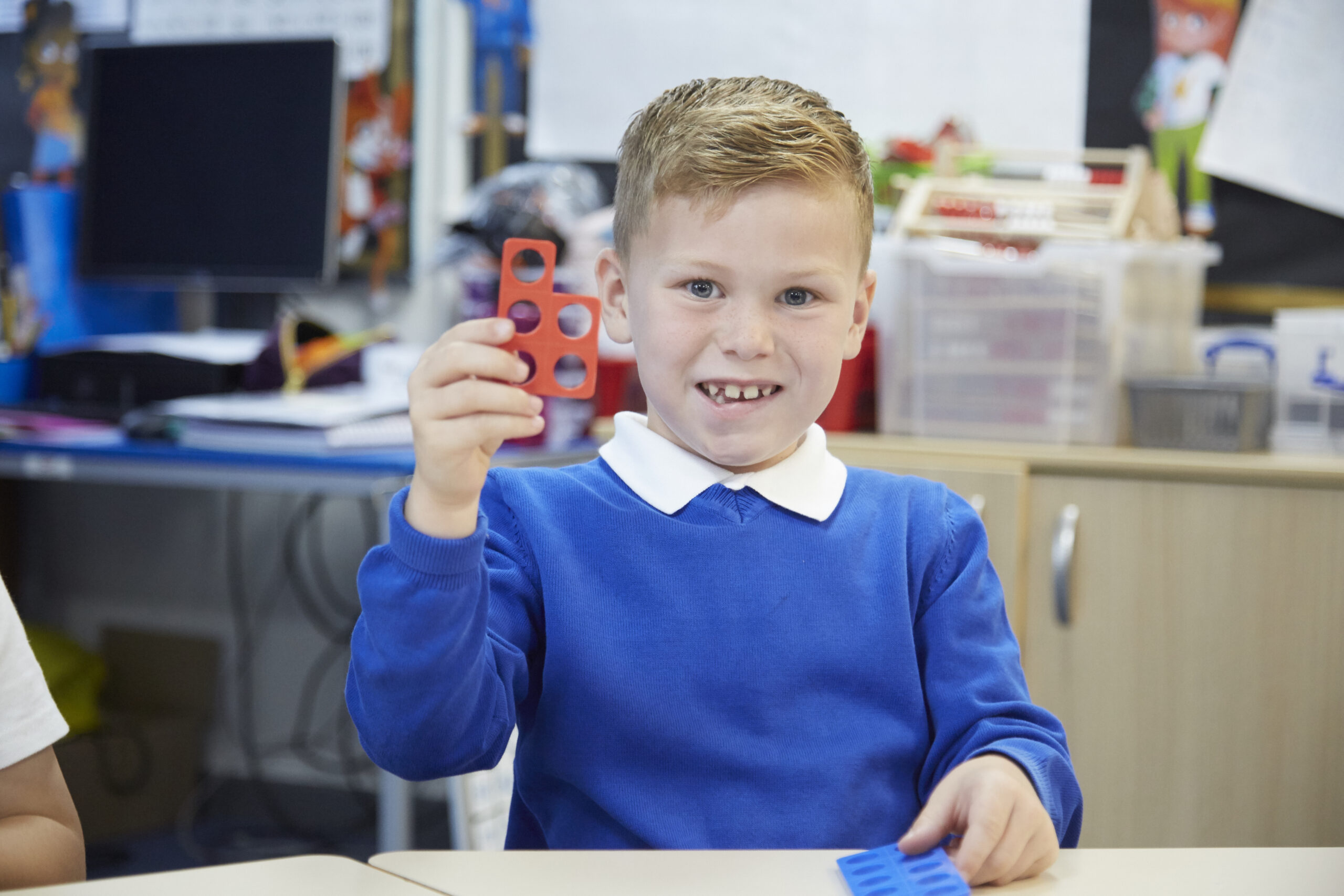
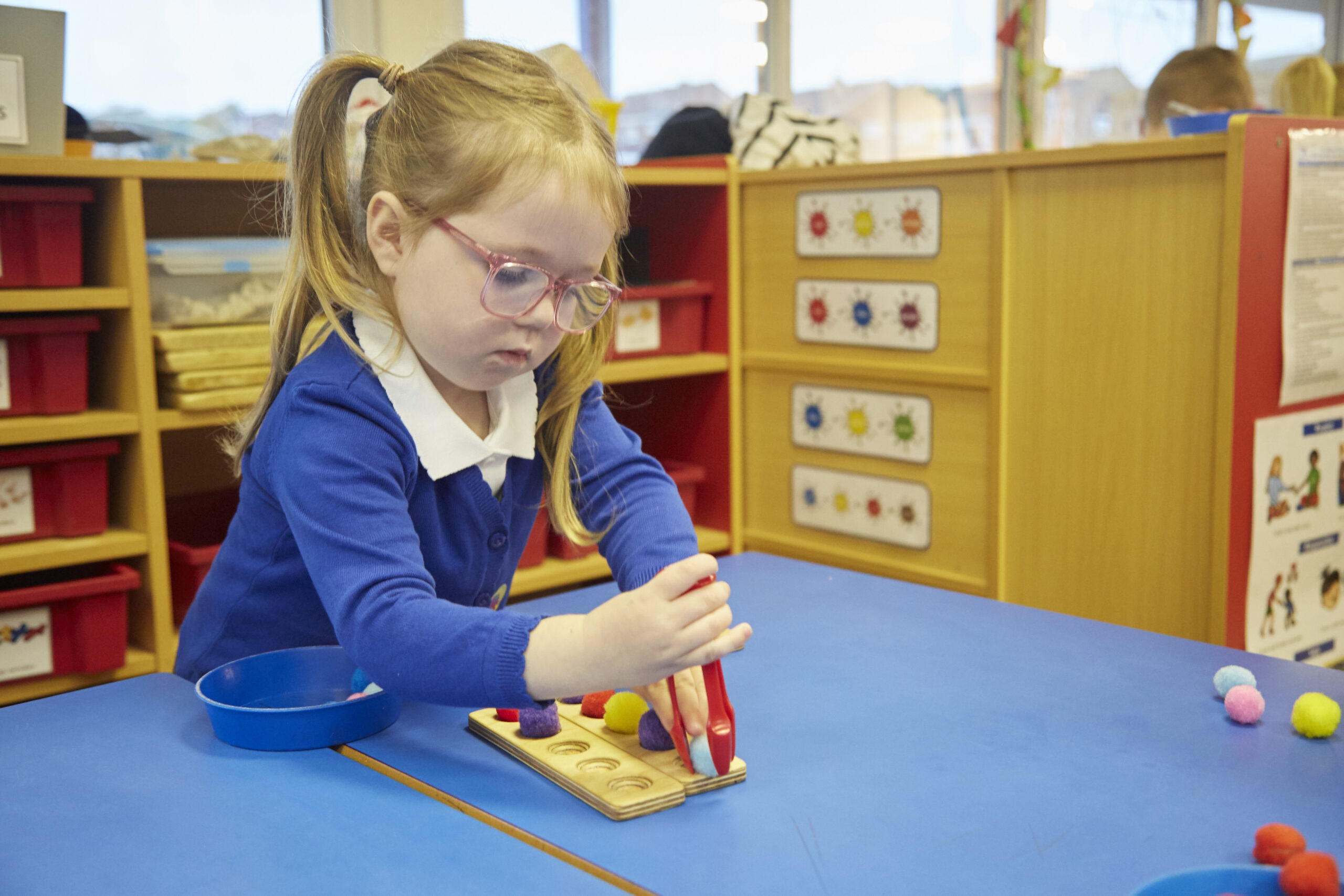
Concrete- Concrete is the active/ “doing” stage where our children use concrete resources to experience objects that are or represent the problem.
Pictorial- Pictorial is the “seeing” stage where visual representations of concrete objects are used to model problems. This stage helps children to make a connection between the physical and the abstract pictures that represent the objects from the problem.
Abstract- Abstract is the “symbolic” stage, where children use abstract symbols such as numbers, notation, and mathematical symbols (for example, +, –, x, /) to model problems.
Our teachers will go back and forth between each stage to reinforce concepts for all our children so they can see the connections between each representation.
Laying the Foundations Early Maths- Mastering Number
Our aim at Acklam Whin is to ensure that all our children develop a strong grounding in number so that all children develop the necessary building blocks to excel mathematically. Children should be able to count confidently, develop a deep understanding of the numbers to 10, the relationships between them and the patterns within those numbers.
Our Reception children follow the Mastering Number Programme and will experience activities and opportunities which collectively provide a platform for everything children will encounter as they progress through their maths learning at primary school, and beyond. The EYFS maths curriculum units taught are:
- Subitising
- Counting, Cardinality and Ordinality
- Composition
- Comparison
Teaching for Mastery
Using the Teaching for Mastery (TfM) approach, our maths curriculum provides a coherent, linked framework and lessons are based on the most important conceptual knowledge and understanding that pupils need as they progress from Reception to Year 6.
Lessons are designed so that objectives are achievable for all. We have high expectations and encourage a ‘can do’ attitude towards mathematics in all pupils. We develop resilience in the face of challenge and carefully scaffold learning so that everyone can make progress.
Maths Lesson Design
All lessons follow the TfM approach of the I do, We do, You do ideology. All lessons start with fluency questions to ensure long term memory is being used and any misconceptions are addressed. Maths vocabulary and stem sentences are modelled by the teacher and also used precisely by the children.
I do, We do– using the TfM small step approach, physical resources represent the learning. Children should be able follow the modelled practice using the ‘I do, We do’ method. Questioning supports the children’s deeper understanding of the structure of the maths. Next, questions using pictorial representations, followed by abstract questions are used.
You do- Children attempt fluency questions using the concrete, pictorial, learning aids and Steps to Success.
Going Deeper -Probing question, problem solving and reasoning activities ensure all children exposed to the essence of the maths learning and any generalisations shared and the children’s understanding deepened.
Maths Mastery Programme
Our children in Reception, Years 1 and 2 are part of the Mastering Number Programme. The project provides secure firm foundations in the development of good number sense for all children from Reception through to Year 1 and Year 2. Our children will leave KS1 with fluency in calculation, a confidence and flexibility with number and develop automaticity and success in the future.
In Years 4 and 5 our children are also participating in the Mastering Number KS2 NCETM project. A deep knowledge understanding of multiplication and division associative relationships is the most important aspect of the KS2 curriculum and is the gateway to success at secondary school. Our pupils in Years 4 and 5 develop fluency in multiplication and division facts, and a confidence and flexibility with number that exemplifies good number sense.
Think and act like mathematicians
Thinking and acting like a mathematician, including talking, writing and reading like is central to our pupils’ learning. Our curriculum is designed to develop pupils’ automaticity, oracy and vocabulary skills to enable them to use and apply mathematical understanding, methods and language meaningfully now and in their future.
The teaching of Maths builds on what has been learnt previously and lays the foundations for further mathematical understanding beyond Key Stage 2. The approach at Acklam Whin will ensure that our children will develop an understanding of mathematical concepts.
Our children will be able to demonstrate deep mathematical thinking, use and apply knowledge and understanding across the subject, be able to reason logically and apply a systematic approach to problem solving and effective communicators of mathematical ideas, facts and concepts. They will also be enthusiastic, self-confident, resilient and willing to take risks and use their initiative.
Knowing more,Remembering more
Maths learning at Acklam Whin happens when our pupils make sense of ideas in relation to what they already know. At Acklam Whin, our children achieve and reach their full potential as the new learning is an alteration to their long-term memory. This learning is effectively the knowledge that stays with us forever so our children can know more and remember more.
At Acklam Whin, our students make excellent progress across the maths curriculum through assessments of both knowledge and skills. In every lesson our children will articulate and reflect on their understanding of the knowledge taught, review their learning and have the opportunity to think deeply. Additional ‘Keep-up’ sessions will be available for any children who require them will be identified quickly and additional support ensures misconceptions are addressed and learning can move forward.
There are also termly summative assessments each term from Years 2-6 which provide a comprehensive measure of our children’s understanding and mastery of the maths that has been taught.
We also share with our children how maths is used within jobs as well as through our Personal Development Promise where we have STEM and Maths clubs specifically aimed at utilising maths and STEM skills in context.
Help at Home
Working in partnership with parents is vital and any support you can give is very much appreciated. With your help, we can achieve our aim that every child really can love and succeed in maths!
Here are some useful links, resources and information on education apps to help you support your child’s learning.